One commercial site, one green roof, one credit. The roof held 40 of the 100 cubic metres of storage the site would otherwise need, and the credit was priced against that share. The bill fell by a seventh. The storage cost fell by two fifths.
What a green roof credit actually offsets, in figures
entered 2026-08-19period FY2026 · Q3 — closes 2026-09-30folio 302kept by The Scupper Ledger (a named ledger, not a person)
The two numbers that get confused
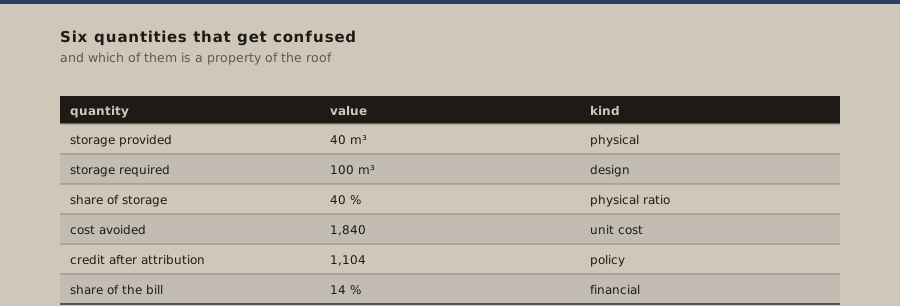
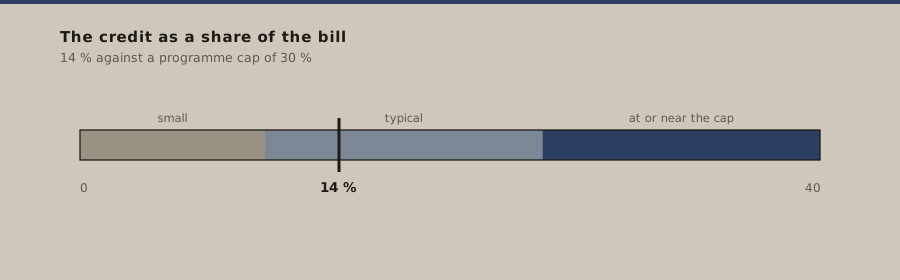
The roof's share of the storage is 40 %. The credit's share of the bill is 14 %. Both figures are correct and they answer different questions. The first is physical: how much water the roof holds. The second is financial: how much of the charge that water is worth. The gap between them is the unit cost of storage and the attribution factor, and neither of those is a property of the roof.

| Quantity | Value | Why |
|---|---|---|
| storage the roof provides | 40 m³ | a physical measurement |
| storage the site requires | 100 m³ | a design requirement |
| roof's share of storage | 40 % | the physical ratio |
| storage cost avoided | 1,840 | at 46 per m³ per year |
| credit after attribution | 1,104 | at a 0.6 factor |
| share of the bill | 14 % | against a 7,800 base charge |
Why the attribution factor exists
The utility did not need all 100 cubic metres of storage at that site. Some of it was required by the development rules, some by the regional plan, and some by a capacity constraint that the site's own runoff did not create. Crediting the site for storage the utility would not have built is crediting it for nothing, and the factor is the correction.
That is why a credit can be defensible and still disappoint the applicant. The applicant measured the roof and got 40 %. The utility measured what it avoided and got 14 %. Both measurements are honest, and the argument at the hearing is about the factor, which is a policy number and not a measurement at all.
A credit is not the same as a rebate and a credit is not the same as a rate reduction. A credit is a deduction applied to a charge before it is billed; a rate reduction changes the price for everybody. The first is targeted at a practice, the second at a class of ratepayer.
What this entry changes
It changes what an applicant should expect and what a utility should publish. An applicant told to expect a credit for 40 % of the storage will receive something nearer 14 % of the bill and will conclude that the programme misled it. A utility that publishes both numbers in the credit manual does not have that conversation.
Documents posted to this account
- 01Equitable stormwater utility fees: an integrated analysis of environmental, socioeconomic, and infrastructure factorssupports the integrated analysis of the environmental and socioeconomic effects of a fee
- 02Stormwater Utility Fees and Household Affordability of Urban Water Services (2022)supports the affordability analysis of stormwater charges on households
- 03Water Affordability Needs Assessment: Report to Congresssupports the national affordability assessment the charge levels are compared with
Each line points at one specific document, with its own title as the link text. No line is a home page and no line is a search result.
open Rule it off and stop Rule it off and stop once you have both numbers: the share of the storage and the share of the bill. They are never the same.