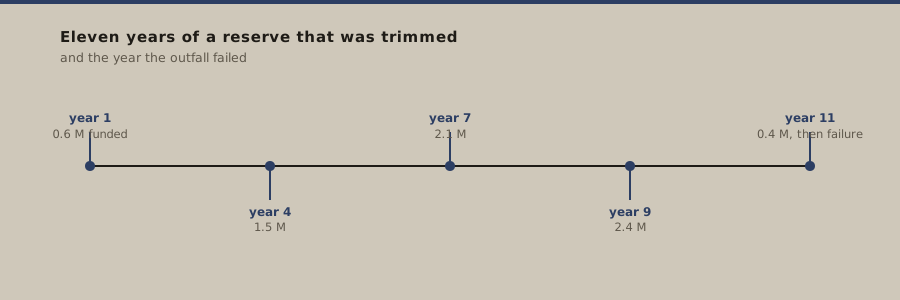
An outfall failed eleven years earlier than its design life suggested. The utility had a reserve balance of 400,000 against a target of 6.2 million, funded the replacement from the operating budget, and borrowed the following year at a rate it did not choose.
The reserve that was not there, and what it cost
entered 2026-08-07period FY2026 · Q3 — closes 2026-09-30folio 303kept by The Scupper Ledger (a named ledger, not a person)
What happened
The reserve had been funded at a nominal amount for nine years. Each year the contribution was trimmed, because operations were over and a reserve is the easiest line to trim. The outfall failed in a wet spring, the replacement was unavoidable, and the money came from the only two places available: the operating budget, which was raided, and a bond issue, which was raised in a hurry.
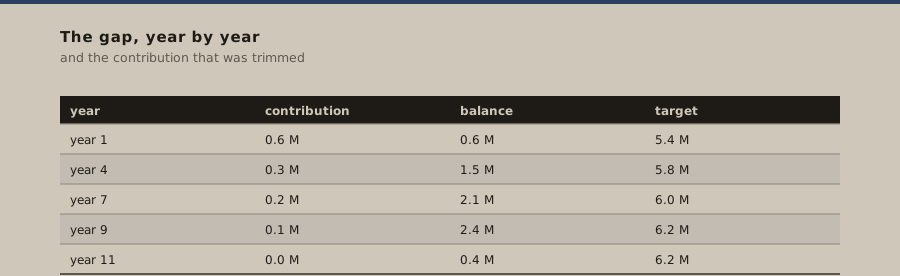
| Year | Contribution | Balance | Target | Gap |
|---|---|---|---|---|
| year 1 | 0.6 M | 0.6 M | 5.4 M | − 4.8 M |
| year 4 | 0.3 M | 1.5 M | 5.8 M | − 4.3 M |
| year 7 | 0.2 M | 2.1 M | 6.0 M | − 3.9 M |
| year 9 | 0.1 M | 2.4 M | 6.2 M | − 3.8 M |
| year 11 | 0.0 M | 0.4 M | 6.2 M | − 5.8 M |
The two costs, and only one of them is on the books
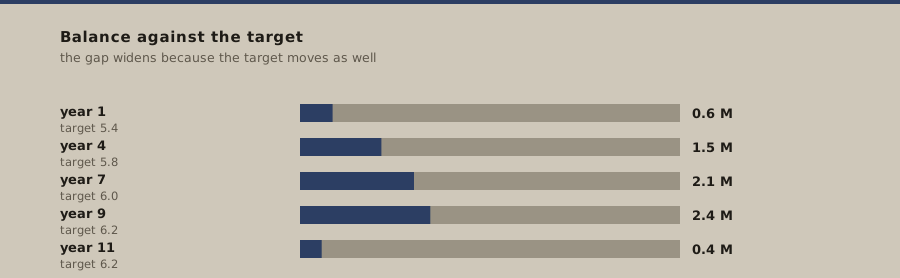
The interest is visible. It appears in the debt service line for twenty years and it is a real, quantified cost of the decision not to fund the reserve. The deferred renewal is not visible. It appears as two projects that slipped, and then as two inlets that failed, and then as a complaint record, and none of those appear as a cost of the reserve decision.
That asymmetry is why the gap survives in utility after utility. The cost of funding a reserve is paid now, by this year's ratepayer, in a line item that is easy to see. The cost of not funding it is paid later, by a different ratepayer, in a form that is spread across several accounts and attributed to nothing in particular.
A reserve balance is not the same as an unassigned fund balance. A reserve is money set aside for a stated purpose and reported as such; an unassigned balance is whatever is left at the end of the year. The first can be planned against; the second disappears into the following year's budget.
What this entry changes
It changes what a reserve contribution should be defended with. A contribution stated as a policy number is trimmed in a tight year. A contribution stated as a schedule with a target and a date is harder to trim, because trimming it is visibly a decision to push the cost onto a later year rather than a decision to save money.
Documents posted to this account
- 01Thames Centre 2024 Stormwater Rate Studysupports the reserve and capital funding structure of a published rate study
- 02Stormwater Utility Rate Analysis Report, Oro Valley AZ (November 2024)supports the rate analysis report whose reserve gap this entry is modelled on
- 032023 Stormwater Rate Study Findings - Lancaster, Ohiosupports the rate study findings that document an underfunded reserve position
Each line points at one specific document, with its own title as the link text. No line is a home page and no line is a search result.
open Rule it off and stop Rule it off and stop once you have the balance, the target and the date the gap closes. The gap is the entry.