A budget-to-actual report compares what was budgeted with what was spent. The number that matters is not the total variance; it is the variance on the lines that will not correct themselves by year end.
How to read a stormwater budget-to-actual report
period FY2026 · Q3 — closes 2026-09-30folio 206kept by The Scupper Ledger (a named ledger, not a person)
The four kinds of variance
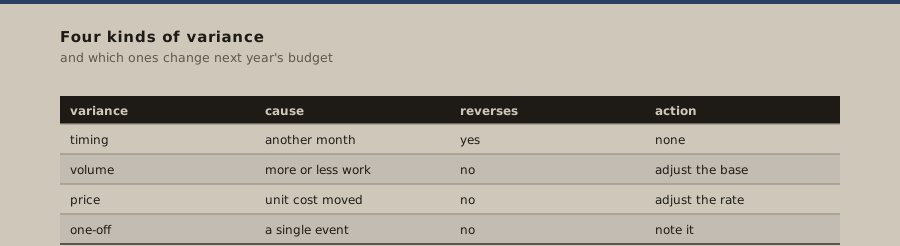
Timing variances reverse themselves by year end and need no action. Permanent variances do not. A volume variance means the work happened at a different rate than assumed. A price variance means the work cost more per unit than assumed. Only the last two change what next year's budget should be, and only if they are permanent.
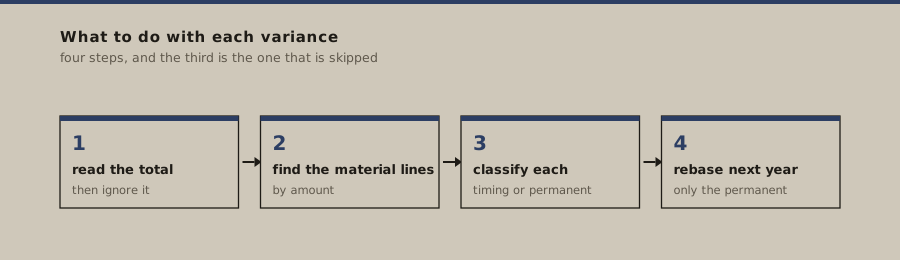
- Read the total variance first, and ignore it until you know what is inside it.
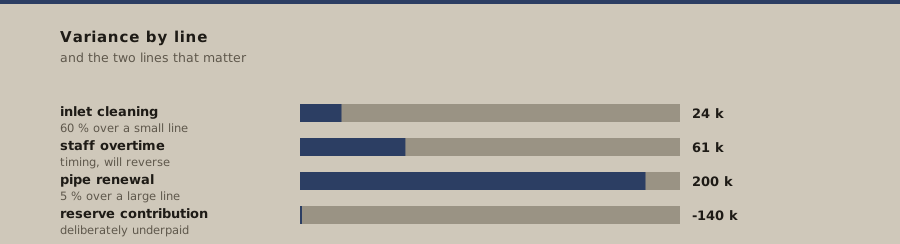
- Find the lines whose variance is more than five per cent of the total budget, not of their own line.
- Classify each of those as timing, volume or price, and say which ones will reverse.
- Carry the permanent ones into next year's budget, and leave the timing ones alone.
| Variance | Cause | Reverses | Action |
|---|---|---|---|
| timing | work done in another month | yes | none |
| volume | more or less work than assumed | no | adjust the base |
| price | unit cost changed | no | adjust the rate |
| one-off | a single event | no | note it, do not rebase |
Why the percentage misleads
A report sorted by percentage variance puts the smallest lines at the top, because a small line can move by a large percentage for a trivial reason. A report sorted by currency variance puts the largest lines at the top, which is the right order for a rate decision and the wrong order for finding an error. Both sorts are useful and a report that offers only one is a report that has chosen an argument.
A budget-to-actual report is not the same as a financial statement, and neither is the same as a rate study. A budget report compares a plan with an outcome for one year; a financial statement reports position and result under accounting rules; a rate study forecasts a revenue requirement for future years. Reading one as another produces a wrong conclusion about a rate.
Where this posting stops
This page covers the reading. The requirement the budget sits inside is owned by the fee account, the programme behind the capital lines by the capital plan account, and the reserve line by the reserve account.
Documents posted to this account
- 012022 Ohio Sewer and Water Rate Surveysupports the rate and charge comparison that a budget variance is measured against
- 02Florida Water and Wastewater Rate Survey 2024supports the current-year rate survey the figures are benchmarked to
- 03Water Rates: Comparing the Costs of Water and Sewage in the United States (2024)supports the national comparison of what households pay for these services
Each line points at one specific document, with its own title as the link text. No line is a home page and no line is a search result.
open Rule it off and stop Rule it off and stop once you know which variances will reverse. The total is not the answer.