A rate is two numbers: what the utility needs to collect, and what it is charging against. The first is built from a budget and a programme. The second comes from a survey of the properties that will pay. Most of the argument is about the second.
How to set a stormwater utility rate, line by line
period FY2026 · Q3 — closes 2026-09-30folio 201recast the figures above move with the periodkept by The Scupper Ledger (a named ledger, not a person)
The five steps
Each step produces a document, and the documents are the evidence a rate can be defended with. A rate that appears without the steps behind it will be challenged at the first public hearing, and the challenge will succeed, because the arithmetic is the only part nobody disputes.
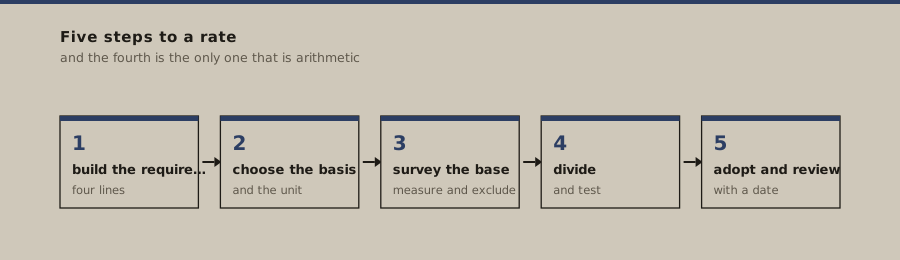
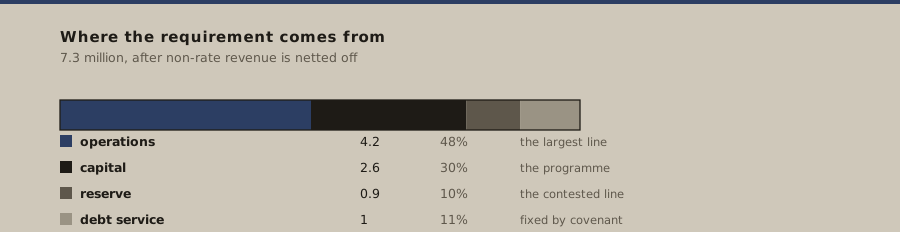
- Build the revenue requirement from operations, capital, reserve and debt service, less any non-rate revenue.
- Decide the billing basis and the billing unit, and write the measurement rule into the ordinance.
- Survey the billing base: measure the impervious area of every billed parcel, and record what was excluded.
- Divide the requirement by the base, then test the result against a typical bill and against the largest ratepayers.
- Adopt the rate, and state the next review date, because a rate without a review date is a rate that will be raised in a hurry.
Where the arithmetic is not the problem
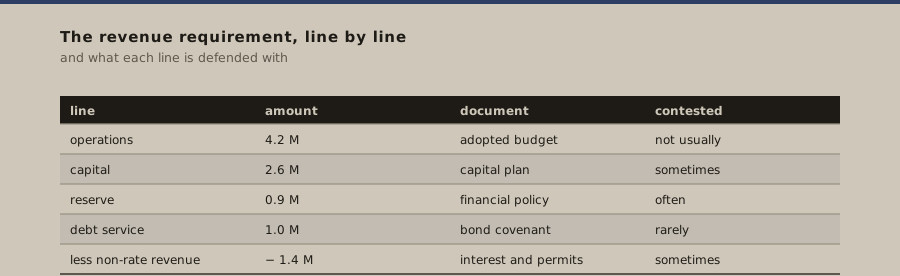
The division is trivial. The two inputs are not. A revenue requirement depends on a programme that a council has to approve, and a billing base depends on a measurement rule that a council also has to approve, and both of those are policy. The rate is the last step and the least controversial part of it.
| Input | Who decides | Document | Contested |
|---|---|---|---|
| operations budget | department and council | adopted budget | usually not |
| capital programme | council | capital improvement plan | sometimes |
| reserve contribution | council | financial policy | often |
| billing basis | council | ordinance | always |
| measurement rule | council | ordinance | always |
A rate is not the same as a bill. The rate is a price per billing unit; a bill is the rate multiplied by the units a particular property has. Two properties on the same street with the same rate can receive bills that differ by a factor of five, and the difference is entirely in the survey.
Where this posting stops
This page covers the procedure. The fee itself is owned by the fee account, the billing basis by the impervious area account, the reserve line by the reserve account, and the borrowing line by the bond account.
Documents posted to this account
- 01City of Mountlake Terrace 2025 Stormwater Utility Rate Study / Revenue Requirement Reportsupports the revenue requirement build and rate derivation in a published study
- 02Final Report: Stormwater Utility Fee Study (BCMUD, July 2024)supports the fee study structure and the billing base survey method
- 03City of Middleton, Wisconsin Stormwater Utility Rate Study (June 2024)supports a recent rate study's cost-of-service allocation and rate design
Each line points at one specific document, with its own title as the link text. No line is a home page and no line is a search result.
ruled off Rule it off and stop Rule it off and stop once the requirement and the base are both documented. The division takes a minute.